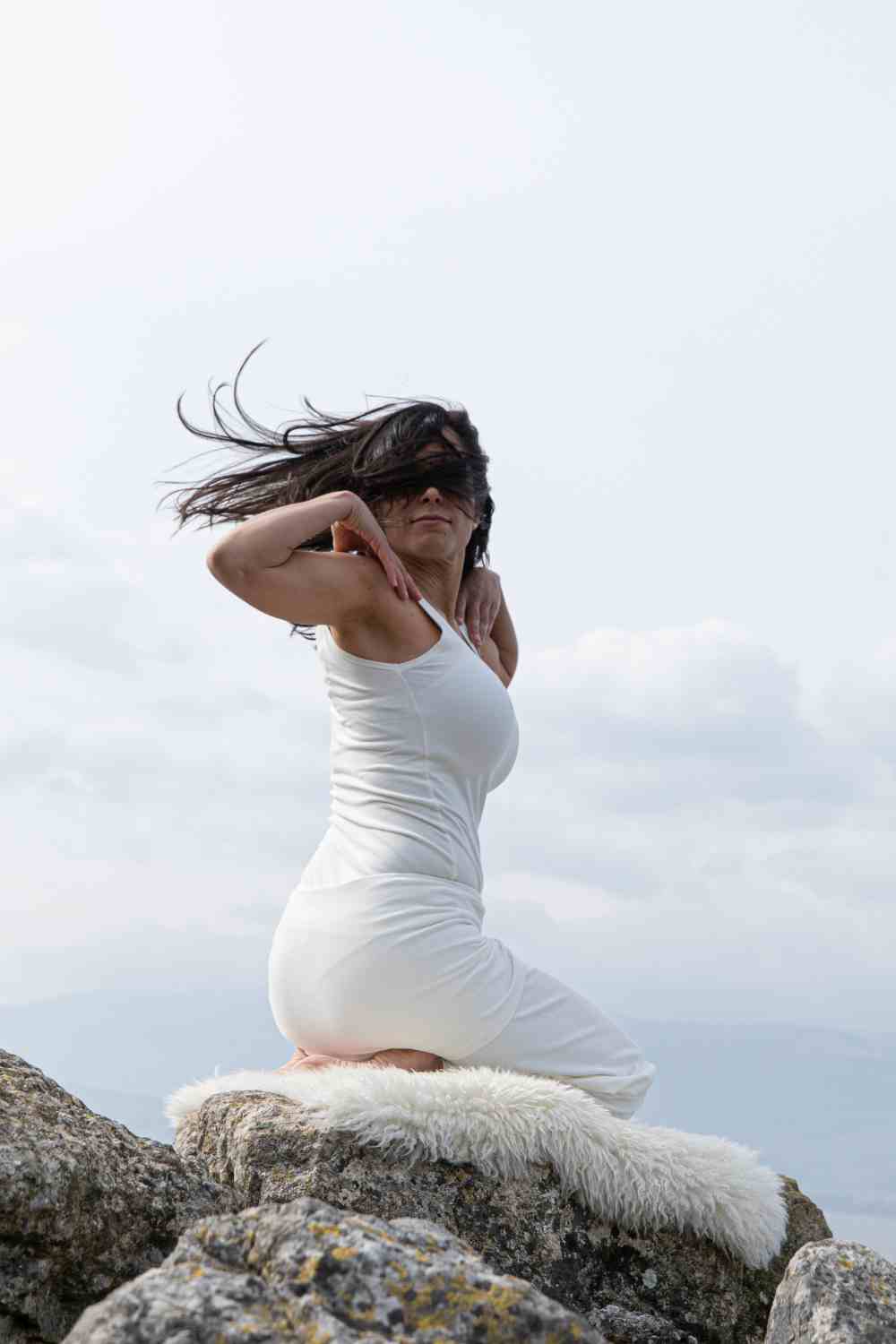

A foot placed gently on the mat. A word held back before it hurts. A body not forced into a posture it is not ready for. Ahimsa, non-violence, is the first step of yoga, long before the first asana. Here is what it means, where it comes from, and how to live it, down to the clothes we wear.
The eight limbs of yoga according to Patañjali
The best-known vision of yoga as a spiritual path in eight steps (Ashtanga, the "eight limbs of yoga") comes from the Yoga Sūtra of Patañjali, a foundational text probably written between the 2nd century BCE and the 4th century CE (Yoga Sūtra 2.29).
These eight limbs are:
- Yama: ethical guidelines in relation to others.
- Niyama: personal disciplines.
- Asana: physical postures.
- Pranayama: mastery of the breath.
- Pratyahara: withdrawal of the senses.
- Dharana: concentration.
- Dhyana: meditation.
- Samadhi: union, the state of awakening.
This system offers a progressive path, from daily behaviour to the most subtle states of consciousness.
Several traditions: 6, 8 or 10 limbs
We spontaneously associate yoga today with Patañjali's "eight limbs". But this framework was not the only one in history.
In earlier or parallel texts, especially those inspired by Samkhya philosophy, we find a system of six stages, with more emphasis on meditation and knowledge.
Other sources, especially in medieval Hatha yoga, speak of ten stages or subdivide the practices even further.
Why, then, did the eight-limbed system become so popular? Because the Yoga Sūtra was widely commented on by influential scholars (Vyasa, Shankara, Bhoja), then revived by modern yoga masters of the 19th and 20th centuries (Vivekananda, Krishnamacharya). Its clear, progressive structure appealed both in India and in the West, and became a kind of "universal grammar" of yoga. Read more in our brief history of yoga.
The Yamas: the ethical foundation of yoga
The Yamas, the first limb, are ethical rules that shape our relationship with the world. Patañjali lists five (Yoga Sūtra 2.30):
- Ahimsa (non-violence),
- Satya (truthfulness),
- Asteya (non-stealing),
- Brahmacharya (moderation, wise use of energy),
- Aparigraha (non-possessiveness).
These principles are like ethical pillars: without them, the practice of postures, breath or meditation loses its deeper meaning.
Ahimsa: non-violence at the heart of yoga
Ahimsa is the first of the Yamas and, for many, the most fundamental. The Sanskrit word joins a- (a negation) and himsa (violence, harm). It literally means "absence of violence".
Historically, the value of Ahimsa already appears in the Upanishads (late Vedic texts), where it is considered a supreme virtue on the way to liberation. It is also at the core of Jainism and Buddhism, traditions contemporary with the rise of yoga philosophy.
In Patañjali's system, Ahimsa goes beyond the absence of physical violence:
- It applies to our actions, but also to our words and thoughts.
- It concerns not only others but also our relationship with ourselves: not mistreating the body through excessive austerity or neglect.
- It extends to nature and all living beings: compassion embraces the whole web of life.
Practising Ahimsa in daily life
To live Ahimsa is to cultivate an attitude of active kindness:
- Replacing inner judgement with acceptance.
- Choosing food that respects life (traditionally, a vegetarian diet).
- Consuming mindfully, reducing excess, favouring choices that respect the environment.
- Cultivating truthful, kind speech that does not humiliate or destroy.
On the mat, Ahimsa is also a bodily compass: listening to your limits, not forcing postures, adapting the practice to the state of the body in the present moment. The breath is a good guide: if it becomes short or jerky, you have gone too far. Our five simple pranayama principles help to come back to it.
Ahimsa and Breath of Fire: clothing with compassion
At Breath of Fire, we see Ahimsa as a living practice, not only on the mat but in the very fabric of what we wear. Choosing clothes made from organic cotton, sewn by people we know and dyed to the OEKO-TEX® Standard 100, Class I (the level required for baby clothes), is a way of honouring non-violence: toward the planet, toward the hands that make our garments, and toward your own skin.
Most of our collection is sewn in the same family workshop in Portugal we have worked with since 2009. Our pieces are designed to be soft on the skin and to last, so that every movement is a gesture of respect. To us, Ahimsa means clothing that accompanies yoga while embodying its values.

Discover pieces like our Nashira jumpsuit in mercerized organic cotton, created to accompany you in daily life and on the mat, with fluid comfort and a conscious design.

Legacy and relevance today
If Patañjali's eight limbs have left such a mark, it is no doubt because they balance ethics, discipline, meditation and transcendence. Ahimsa, placed first, reminds us that every spiritual or physical practice must begin with kindness.
In a world seeking ecological and social balance, Ahimsa resonates as a timeless principle: caring for ourselves, for others and for the planet, by cultivating a gentle yet radical strength.
"When Ahimsa is firmly established, all hostility ceases in the presence of the yogi." Yoga Sūtra 2.35
Frequently asked questions
What does Ahimsa mean?
Ahimsa is Sanskrit for "non-violence" or "non-harming": a- (not) and himsa (harm). It is the first of the five Yamas in Patañjali's Yoga Sūtra (2.30).
Why is Ahimsa the first Yama?
Because every other practice rests on it. Truth without kindness can hurt, discipline without kindness becomes violence toward oneself. Ahimsa sets the tone for the whole path.
How can I practise Ahimsa on the yoga mat?
Listen to your body, never force a posture, and let the breath stay calm and even. Rest when you need to. Kindness toward yourself is the first form of non-violence.
Does Ahimsa mean being vegetarian?
Traditionally, many yogis understood Ahimsa as a call to a vegetarian diet. Today, everyone interprets it according to their own path. The heart of it is to reduce, as far as possible, the harm we cause.
Further reading and references
Classical texts
- Yoga Sūtra of Patañjali (2nd century BCE to 4th century CE).
- The Upanishads (especially Chandogya and Brihadaranyaka).
- The Mahabharata (especially the Bhagavad Gītā, which echoes the spirit of Ahimsa).
- Texts of Samkhya philosophy, the metaphysical foundation of yoga.
Parallel traditions
- Jain writings on Ahimsa (for example the Acaranga Sutra).
- Buddhist teachings on compassion (karuna).
Commentators and modern voices
- Swami Vivekananda, Raja Yoga (1896).
- T.K.V. Desikachar, The Heart of Yoga.
- B.K.S. Iyengar, Light on the Yoga Sūtras of Patañjali.
- Gandhi, All Men Are Brothers (the political application of Ahimsa).
By practising Ahimsa, in thought, in action and even in the way we dress, we live yoga as a path of care and awareness.
Gentleness first. Everything else follows.