A seal pressed in clay, a figure sitting cross-legged. A chant passed from mouth to ear. Yoga is older than writing in many places, and it has travelled far. Here is a short history of yoga, from the Vedas to the studios of Europe, and the eight limbs that still hold it together.
Yoga is an ancient discipline that weaves together ethics, posture, breath, concentration and meditation. It was born as a spiritual path, a way to unite body and mind and to look beyond both. Its story spans several thousand years. It began in ancient India, then was carried, adapted and reinvented by many cultures.
Let's walk through a brief history of yoga in Asia and in the West, and look more closely at its key concepts.
The origin of yoga
The Vedic texts, the oldest sacred texts of India, were composed and transmitted orally over many centuries. They gather four founding collections, the Vedas, which tradition presents as truths revealed to the great sages of a primordial age. A seal from the Indus Valley civilisation, showing a figure seated in a posture close to a yoga pose, has led many historians to place the first traces of yoga more than 4,000 years ago. These early practices were postures, rituals and prayers (mantras), passed on by word of mouth and changing with time and their cultural setting.
From around 700 BC come the Upanishads, collections of philosophical texts with one central theme: a universe centred on a higher, eternal consciousness. The yoga of this period is called pre-classical yoga.
The Bhagavad Gita, part of the great Indian epic, the Mahabharata, develops clearer ideas about yoga. Each of its 18 chapters is named after a form of yoga, and it describes paths such as Bhakti yoga (devotion), Karma yoga (action) and Jnana yoga (knowledge).
Traditions then took shape, and six classical philosophical systems were distinguished, the Darshanas. Yoga and Samkhya are two of them. Here, yoga is described as a method for the liberation of the whole being. Samkhya, closely related, is a theory of how consciousness becomes bound to matter and how it can be freed.
Drawing on these two schools, the first fundamental text of yoga appears: the Yoga Sutras of Patanjali, written down somewhere between 200 BC and 500 AD (there is no precise date). It is the basis of what we call classical yoga. Its 195 or 196 aphorisms, depending on the edition, offer a guideline built on eight aspects of practice: Ashtanga, the eight limbs.
The 8 limbs of yoga (Ashtanga)
- Yama: rules of behaviour
- Niyama: self-discipline
- Asana: body posture
- Pranayama: the art of breathing
- Pratyahara: withdrawal of the senses
- Dharana: concentration
- Dhyana: meditation
- Samadhi: absorption, enlightenment
1. Yama: rules of behaviour
The Yamas are the ethical rules of yoga philosophy, our relationship with others and the world. The Yoga Sutra (2.30) names five: Ahimsa, non-violence, Satya, truthfulness, Asteya (non-stealing), Brahmacharya (moderation, the right use of energy) and Aparigraha (non-possessiveness).
2. Niyama: self-discipline
The Sanskrit word niyama means "observance". The Niyamas complement the Yamas: they concern our relationship with ourselves. The Yoga Sutra (2.32) lists five: Saucha, purity, Santosha (contentment), Tapas (inner fire, discipline), Svadhyaya (self-study) and Ishvara Pranidhana (surrender to something greater).
3. Asana: body posture
Asanas are the physical postures of yoga. In the Yoga Sutra (2.46), asana is simply a seat that is "steady and comfortable" (sthira sukham asanam). Over the centuries, the postures multiplied. Practised regularly, they strengthen joints, ligaments and muscles and improve flexibility and balance.
4. Pranayama: the art of breathing
Pranayama is the art of regulating the breath. The Sanskrit word joins prana, life energy, and yama (or ayama), control or extension. If you want to try it, our guide to six pranayama techniques is a good place to start.
5. Pratyahara: withdrawal of the senses
Pratyahara is the fifth limb and the threshold of meditation. It is one of the least known. The attention turns away from outside stimulation and comes back inside, so the senses stop pulling the mind in every direction.
6. Dharana: concentration
In Sanskrit, dharana means "holding". It is the practice of fixing the mind on a single object, place or idea: a flame, a mantra, the breath. Its scope is narrower than that of Dhyana.
7. Dhyana: meditation
Where Dharana is effort, Dhyana is flow. The attention no longer needs to be held: it rests, unbroken, in its object. Dhyana is translated as meditation, a state of deep serenity.
8. Samadhi: absorption
Samadhi is the highest state described by Patanjali, in which the separation between the one who meditates and the object of meditation dissolves. Individual and universal consciousness unite.
Easy to read, much less easy to fully understand, these aphorisms invite thought, discussion and meditation. Knowing them is part of every practitioner's "must".

Tantra and Hatha yoga
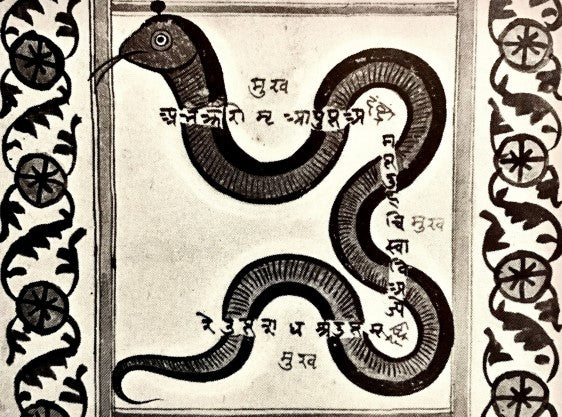
Tantra developed from around 500 AD, rather freely, in the north of India. It was a kind of counter-current to the normative Hindu system, based on practice and oral transmission. Tantra is a mystical way that honours the body and sees it as a vessel of divine energy. The feminine aspect is highly valued. In this context, practices such as Kundalini yoga and Tantra yoga developed around the balance of Shiva and Shakti, masculine and feminine energies. To learn more, read our article on Kundalini yoga.
Later, Hatha yoga placed the body at the centre of the work, with postures, breathing and cleansing practices. Its reference text, the Hatha Yoga Pradipika (15th century), is another "must" for the beginner.
The history of yoga in Europe
Around the year 1000, the Persian scholar Al-Biruni translated the Yoga Sutras of Patanjali into Arabic, helping the text circulate in the Middle East. These teachings, along with certain Tantric techniques, influenced the practices of Sufism.
Sufism in turn influenced European mysticism, and it is striking to see how close the symbols of alchemy are to those found in yoga or Tantra.
The European travellers and missionaries of the 16th century remained rather the spectators of an India they did not understand, and made no distinction between a true spiritual quest and fakirism. It was only towards the end of the 19th century that the West truly opened itself to Indian and Eastern thought.
Among the masters who most influenced Europe were Sri Aurobindo, Swami Vivekananda, Maharishi Mahesh Yogi and Swami Sivananda. Western psychology also began to take an interest in Eastern ideas: in 1932, Carl Gustav Jung gave his famous seminar on Kundalini yoga. Interpretations were not always accurate, but a door had opened. With the student movements of the 1960s, yoga really took off in Europe as a meditative discipline.
A brief history of yoga in the United States
At the turn of the 20th century, Swami Vivekananda, then Paramahansa Yogananda and Indra Devi, were among the first teachers to bring yoga and its philosophy to the United States. In the 1960s and 1970s, they were followed by masters such as Muktananda, Desikachar, Pattabhi Jois and B.K.S. Iyengar, to whom we owe Ashtanga yoga and Iyengar yoga.
Yogi Bhajan is also among them: he brought Kundalini yoga to the West at the end of the 1960s. Today, the United States and Canada have countless centres and schools, with a strong focus on physical yoga. Power yoga, inspired by Ashtanga, is very popular, and you can also find more unusual forms, such as "doga", yoga with your dog.
Current yoga trends
Westerners are slowly making yoga culture their own. Even if our mentality and traditions remain deeply rooted in a Judeo-Christian culture, openness to the world brings us into contact with many belief systems, and mixtures are made without much hesitation. A basic knowledge of the different philosophies helps to avoid confusing amalgams.
For many people today, yoga offers a living alternative to religious forms that feel frozen. Yoga can also be experienced alongside any religion, as a concrete approach to the ultimate reality. And for those who do not feel at home in any religion, yoga makes it possible to live a spirituality of their own, through experience.
The last decade has seen a worldwide boom, with millions of practitioners of every style, and a clear preference for Hatha yoga, based on physical exercise. Even India has been touched by this wave and has rediscovered the treasure rooted in its own ancient tradition. If you are just starting out, our guide to the best type of yoga for beginners will help you choose.

Closing words
I hope this history of yoga will be useful to you, but please keep in mind that it summarises a much richer and more complex story. I hope it will inspire you to learn more about yoga, from ancient to modern times.
At Breath of Fire, we have long lived yoga as a philosophy of life and an art of living. All our clothing is created with this in mind, in natural fibres, sewn in a small family workshop in Portugal since 2009.
Be in your strength. Lia
Frequently asked questions
What is the history of yoga, in short?
Yoga comes from the Sanskrit root yuj, "to unite". Its first traces go back to the Indus Valley civilisation in northern India, more than 4,000 years ago. It was shaped by the Vedas and the Upanishads, structured by Patanjali's Yoga Sutras, then extended by Tantra and Hatha yoga, before reaching the West at the end of the 19th century.
What are the eight limbs of yoga?
Ashtanga joins two Sanskrit words, ashta, eight, and anga, limb. The eight limbs described by Patanjali (Yoga Sutra 2.29) are Yama, Niyama, Asana, Pranayama, Pratyahara, Dharana, Dhyana and Samadhi: a set of principles for living a meaningful life.
What are the spiritual benefits of yoga?
Practitioners often describe a better ability to focus, more inner calm, more self-knowledge and a sense of harmony between body and mind. Traditionally, these are steps on the way, not the goal: the goal of yoga is the stillness of the mind (Yoga Sutra 1.2).
Besides India, have other cultures practised yoga?
The word yoga comes from India. But similar practices were adopted by Buddhist ascetics, in the Bön tradition of Nepal and Tibet, and influenced Christian and Muslim mystics such as the Sufis. In every culture, people have sought ways to rise above their materiality and their time.
An old path. Still walked, one breath at a time.