Yin Yoga slows the body down so the mind can follow. Long-held postures, deep stillness, and the patient stretch of what asana usually does not reach — the connective tissue, the fascia, the breath beneath the breath.
Where Vinyasa builds heat, Yin invites cool stillness. Where Ashtanga moves, Yin stays. Each posture is held for three, five, sometimes seven minutes — long enough for the muscles to release, and the deeper layers of the body to begin their own slow opening.
Where it comes from
Yin Yoga traces back to Taoist yoga, an older Chinese practice that worked with the energetic meridians of the body. The yin principle — receptive, passive, cooling — is set against the yang — active, heating, dynamic. Yin Yoga is not the absence of yang. It is its complement.
The contemporary form was shaped in the 1970s by Paulie Zink, then taught more widely by Paul Grilley and Sarah Powers. Today it is practiced in studios across the world, often as a counterpoint to faster styles.
What it does
- Stretches the connective tissue. Muscles relax in seconds. Fascia and ligaments take minutes. Yin works on what active practice cannot reach.
- Calms the nervous system. Slow breath, long stillness, parasympathetic activation. The body shifts from "do" to "be."
- Improves circulation. Held postures with intentional breath increase blood flow to specific zones.
- Cultivates mindfulness. Three minutes in a held posture is a long time to be alone with the mind. Yin is meditation in disguise.
How to begin
A quiet space. A mat. A few props if you have them — a bolster, two blocks, a blanket. Loose, draping clothing that does not pull. Wide pants like our Sohang or Yamala are the natural companion — they let the body fold without resistance.
Three postures to begin :
- Seated forward fold (paschimottanasana). Sit with legs extended, fold forward gently. No straining. Three to five minutes. Use a bolster under the chest if needed.
- Butterfly (baddha konasana). Soles of feet together, knees fall open, fold forward. The hips open over time, not by force.
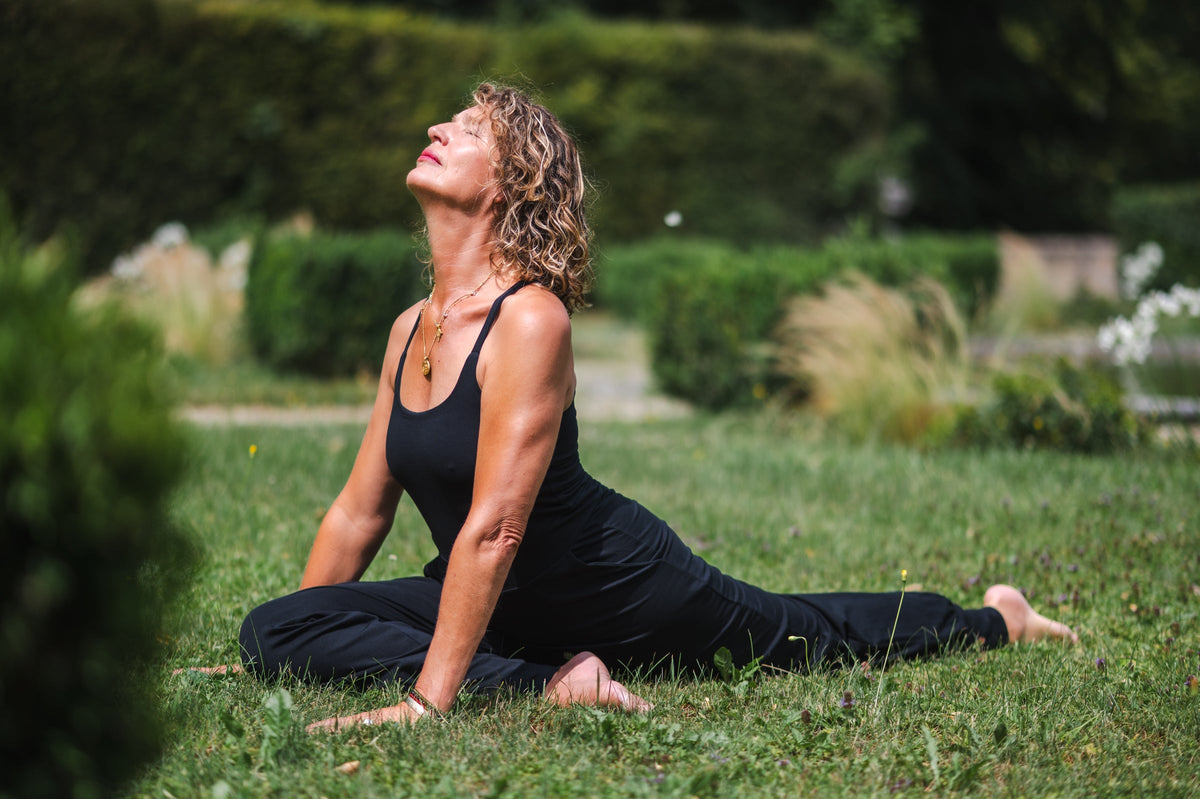
- Sphinx pose. Lie on the belly, forearms on the mat, lift the chest gently. Opens the front of the body without compression.
Stay long enough that the body settles. Let gravity do the work. The opening is not in the muscle — it is in the patience.
What Yin asks for
Loose clothing. A still space. Time you protect from the rest of your day. And the willingness to do less and feel more.
Yin teaches the body that softness is also strength. That receiving is also doing. That breath is the practice — the rest is decoration.